The brief covered a recent MCM Advanced Tactical Training program, the final pre-deployment mine warfare assessment for LCS crews.
Some key findings:
Unreliable unmanned systems. Each Fleet-class USV mission requires over four hours of “pre-mission maintenance” and “1.5 hours of GPS/sonar calibration once launched,” according to the presentation. Multiple hunt missions were conducted where the sonar simply failed to record data — and crews didn’t know until the post-mission analysis. This is especially damaging during reacquire-and-identify missions, exactly the kind of work needed to clear a minefield.
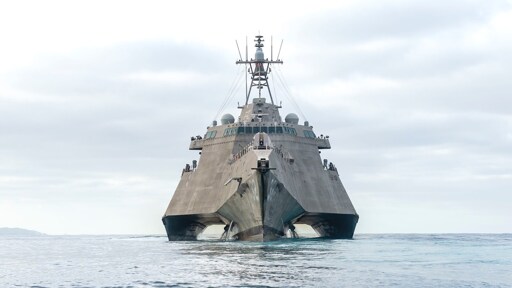
Operators have responded by shortening mission times, which defeats the purpose of using unmanned vehicles in the first place. One pre-deployment exercise with the USS Tulsa off the coast of San Diego resulted in a runaway MCM USV near Mexico’s territorial waters that could not be recovered by the mothership LCS. “Literally, the practice minefield I use is 1 mile north of the US-Mexico maritime border, and there’s a good chance that that UUV drifts or decides to go off on its own. I’m going to get demarched by the Mexican government,” said the leader of the U.S. Navy’s Mine Countermeasures Technical Division. The USVs themselves act as a handicap to minesweeping, with a short bandwidth range forcing the mothership LCS to operate near or inside minefields to maintain visual range to the USV’s antennas.
Visual identification doesn’t work. U.S. MCM doctrine requires a camera to visually confirm mines — the AQS-20 has to drive directly over a bottom mine. But even the relatively clear waters off Southern California have defeated this approach. In the turbid, shallow, current-swept waters of the Persian Gulf, the problem would be far worse. The officer’s conclusion: The Navy needs to adopt high-granularity sonar identification, as other navies already have.
Critical single-point failures. The platform lift between mission bay and hangar, the BIT test laptops for the USV/ALMDS/AMNS, the twin boom extensible crane, and the payload handling systems are all single-point failures with no spares or redundancy aboard. If any one of these breaks, operations stop. When describing the deployment arm, the Navy mine countermeasures lead said, “It is a troubling system. It is highly complex for what it does, and when it breaks, I’m out of a job, I’m out of a mission.”
Multi-mission dilution. The LCS was designed as a multi-mission platform. The addition of Naval Strike Missiles and pressure to support visit, board, search, and seize operations means crews have less time to build and maintain MCM proficiency. “So now my ship with an LCS mission package may not necessarily be practicing MCM.” The LCS platform is also being experimented on as a long-range strike platform. The director’s own conclusion: The LCS will always struggle to match a dedicated MCM vessel.


It’s really worth reading: https://hntrbrk.com/demining-hormuz/ which TWZ references regarding the demining.
The ending is below as I just had to shake my head and slap my face.
Raytheon’s promo page for the AQS-20 for reference.
https://www.rtx.com/raytheon/what-we-do/sea/minehunting-sonar
https://en.wikipedia.org/wiki/AN/AQS-20A